Abbycar Road Trip Hub: Salty Digital’s AI-driven SEO strategy that won Gold at the Search & Discovery Awards

Salty Digital, an SEO agency specializing in Technical SEO, Programmatic SEO, and Generative Engine Optimization (GEO), designed an AI-driven SEO strategy for Abbycar that linked informational search demand related to road trips with commercial intent for car rentals.
Can SEO do more than just drive traffic to a website in the travel industry? Can it understand what kind of trip a user wants to take, help them plan it, and ultimately guide them naturally toward a conversion?
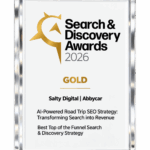
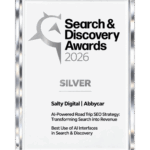
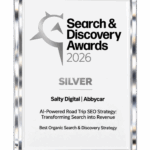
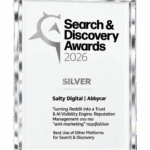
This was the rationale behind the Road Trip Hub we designed for Abbycar, the multinational car rental company, creating an innovative methodology that won the Gold award at the Search & Discovery Awards in the category “Best Top-of-the-Funnel Search & Discovery Strategy,” while it was also recognized in the second category, “Best Organic Search & Discovery Strategy,” where it won the Silver award.
Featured in the media
Salty Digital’s award-winning approach was also featured by Forbes Greece, Capital.gr, and Dnews.gr



Instead of treating road trips as just another informational content topic, we created an AI-powered ecosystem of dozens of landing pages, designed around different search intents and real travel needs.
The result was something far more impactful than a content hub—it was an SEO asset that functions as a decision-making tool, linking search to purchase intent and transforming the organic channel into an acquisition funnel.


+132%
New Customers
+58%
Organic Clicks
+118000
Impressions
✅ The challenge was not to get more traffic, but better traffic
For businesses in the travel industry, traffic alone isn’t enough.
A user looking for general information about a destination might visit a site and leave without making a purchase. In contrast, a traveler planning a multi-day road trip is much closer to needing to rent a car.
That’s where we saw the opportunity.
The goal wasn’t simply to increase Abbycar’s organic traffic. We wanted to attract high-intent travelers who were more likely to need a car for several days and to create a journey that would guide them from their initial inspiration to selecting the right vehicle.
Thus, SEO had to stop functioning exclusively as a traffic channel and become much more directly linked to the commercial value of each organic visitor.
✅ The idea behind the strategy
The traditional travel content strategy is usually based on individual articles about each destination that inform visitors about attractions, activities, and other useful information.
We took a different approach, focusing on what someone needs to decide which road trip is right for them.
The problem, of course, is that the answer isn’t the same for everyone. A couple is looking for one kind of trip, while a family is looking for another. It’s one thing for someone who has four days to spare and quite another for someone planning a two-week trip. Some routes appeal to travelers seeking nature and adventure, while others appeal to those more interested in history and culture.
This led us to the central idea behind our methodology. Instead of asking the user to search through the content, we decided to create an ecosystem that tailors content discovery to the user’s specific needs.
✅ The Methodology: User-Centric Semi-Programmatic SEO
So, we created an AI-powered Road Trip Hub based on a semi-programmatic SEO model.
Semi-Programmatic SEO is a more controlled application of Programmatic SEO, where automation and AI are used to scale, while the strategy, quality, and usefulness of each landing page remain the focus.
The idea was to make the process scalable, but we were in no way interested in mass-producing content.
Using AI workflows and AI tools, we created automated processes for researching, evaluating, verifying, and producing content, enabling us to develop hundreds of different road trip pages.
Users could discover routes based on:
- the continent and country
- the season
- the duration of the trip
- the type of traveler
- the desired trip characteristics.
In this way, we created content on a large scale without compromising its quality or relevance. Instead, AI was used to create a much more personalized discovery experience.

✅ A real travel tool
Since we didn’t want to create hundreds of pages that would simply rank well, but wanted each road trip to be truly useful when a user landed on it, every landing page was enriched with rich media and elements that address the traveler’s various needs:
- Interactive Route Maps, so users can practically understand the route.
- Reddit Reviews and real user insights, so the experience is enriched with social proof and the opinions of real travelers.
- Themed Spotify Playlists, designed for that specific road trip and integrated into the travel experience itself.
Content, UX, and search were therefore not treated as separate components but were integrated into a unified environment that helps the user progress from a simple search intent to the decision to travel and the final purchase.
✅ The Connection to Commercial Intent
The connection between this SEO asset and purchase intent was the key factor that ultimately set this methodology apart from any other SEO strategy.
Informational queries have enormous search potential, but for a commercial brand, traffic is naturally much more valuable when it can be organically linked to the product.
That’s why each road trip didn’t end with just travel information, but was linked to a specific recommendation for a suitable rental vehicle, depending on the needs of the trip.
The rental recommendation wasn’t presented in isolation from the content. It was the logical next step for travelers who had already decided which route they wanted to take.
Thus, Road Trip Hub ceased to be merely a content strategy and evolved into a performance-driven SEO funnel.
✅ AI for scale, not for mass-produced content
Artificial intelligence was a key part of the methodology, but not as a means of writing hundreds of similar articles of minimal value.
It was utilized at multiple stages of the process, from research and evaluation to categorization, verification, and the creation of various assets.
The idea was to use automation to achieve something that would be extremely difficult to create manually: to create hundreds of different, structured, and intent-driven experiences centered around road trips.

✅ Salty Digital’s SEO Approach
Road Trip Hub is a prime example of Salty Digital’s SEO methodology, in which Technical SEO, search intent, Programmatic SEO, content strategy, UX, CRO, and Generative Engine Optimization (GEO) are treated as parts of a unified growth framework.
The goal is not only to increase organic traffic but also to create SEO assets that link organic search to real business objectives and measurable results.
✅ What We Achieved
The most important metric for the project was the Average Order Value, which rose from €85.81 to €198.63, a 131% increase, even though Road Trip Hub was launched during the travel industry’s off-season.
This result was a direct consequence of the strategy’s approach, as the new content ecosystem attracted travelers interested in multi-day road trips and larger vehicles—features associated with higher booking value.
At the same time, since the launch of the Road Trip Hub, we recorded:
- +132% new customers
- +58% organic clicks
- 118,000 impressions
- an improvement in average organic ranking to 7th place, up from the second page
- 92% retention rate among users who searched directly for Abbycar during the off-season
Finally, our strategy yielded exceptionally beneficial results not only for the site’s organic presence but also for its visibility on LLMs. Salty Digital implements a structured Generative Engine Optimization (GEO) methodology, with the goal of ensuring that content is understandable and usable not only by traditional search engines but also by AI search experiences and Large Language Models (LLMs).
As a result, the road trip pages received 8,000 AI citations/mentions within the first three months, according to Google and Microsoft’s AI reporting tools, turning LLMs into a source of additional traffic for the site.
Based on these metrics, it is clear that not only was greater organic visibility achieved, but also greater commercial value from the audience reached by the brand.
✅ The Award-Winning Innovation
This methodology was recognized because it succeeded in combining, within a single system, components that are often implemented in isolation.
Starting with search intent and AI automation, we took the approach several steps further by incorporating UX strategy, real-user insights, rich media, conversion strategy, and GEO into the strategy.
After all, the goal was for the entire hub to address the business need to connect the right traveler at the moment they’re planning their trip and to naturally guide them from search to booking.
Beyond the award, however, the most important insight from the project for us is that the next stage of SEO isn’t just about how to improve your rankings.
It’s about how you can transform search into a complete discovery experience and, ultimately, into measurable business value.